
World's best Sourdough Stollen (traditional recipe)
Stollen is the German Christmas bread, a rich butter dough full of rum-soaked raisins, candied orange and lemon peel and almonds, sealed in butter and powdered sugar. Almost every Stollen today is raised with commercial yeast. Mine is raised only with a stiff sourdough starter. The result is a mind-blowing Stollen that is unbeatable in terms of flavor, and it keeps for months.

The schedule
You need about one and a half hours of work, spread over four evenings and one dough day. The rest is waiting. The times below are an example for a Saturday bake. Tap a step to jump to its details.
Wednesday, 3 days before
- 8 pm: Make your starter stiff. 10 g starter, 50 g flour, 25 g water
Thursday, 2 days before
- 8 pm: Feed it again. 10 g of the stiff starter, 50 g flour, 25 g water
Friday, The evening before
- 8 pm: Build the starter for the dough. 15 g stiff starter, 150 g flour, 75 g water
- 8:15 pm: Soak the fruit in rum. At least 8 hours
Saturday, Dough day
- 8:30 am: Drain the fruit. 30 minutes in a sieve
- 9 am: Mix the dough, fold in the fruit. 5 minutes of kneading
- 9:20 am: Let it rise by about 25 %. 8 to 14 hours, keep it warm
- 6 pm: Divide and shape. Two Stollen, folded with a step
- 6:15 pm: Let the Stollen proof. One hour under a damp towel
- 6:45 pm: Turn on the oven. 180 °C (350 °F), no fan, while they keep proofing
- 7:15 pm: Bake under a tray. About 60 minutes, until 92 °C (197 °F) inside
- 8:15 pm: Butter it while hot. Then let it cool for an hour
- 9:15 pm: Butter again, coat in sugar, wrap. Every spot covered
Sunday, And after
- From Sunday: Cut the first slice. It keeps getting better for weeks
Example times. Your starter and your kitchen set the pace: the dough may need 8 to 14 hours to rise. If it is not ready by the evening, it spends the night in the fridge and you bake on Sunday morning.
The whole recipe in one picture
All 12 steps with my own photos, the times and temperatures, the three things that matter and the ingredients for two Stollen. Save it for your Stollen weekend. You are welcome to share it, and a link back to this page is appreciated.
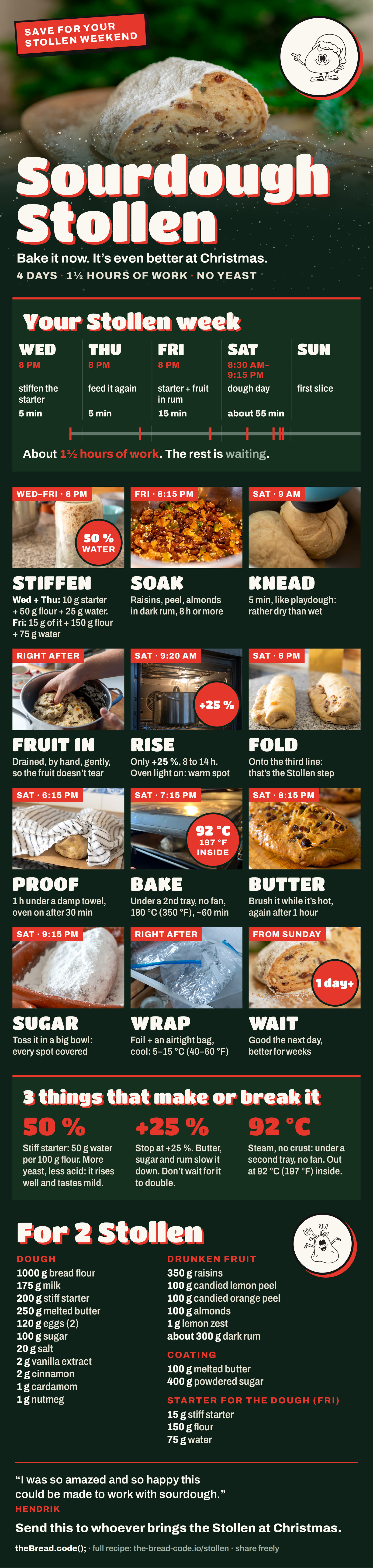
Tap the picture for the full size.
Ingredients
How many Stollen do you want to bake?
Amounts for 2 Stollen.
I am providing baker’s math percentages, so you can scale the recipe to any size. The base is 1000 g of flour for two Stollen of about 1.3 kg of dough each.
For the starter, the evening before the dough day:
| Ingredient | Weight in grams | Comment |
|---|---|---|
| Stiff sourdough starter | 15 grams | |
| Bread flour | 150 grams | |
| Water | 75 grams | Makes a little more than you need. Keep the rest. |
Drunken fruit, also the evening before:
| Ingredient | Weight in grams | Baker's math | Comment |
|---|---|---|---|
| Raisins | 350 grams | 35.00% | |
| Dark rum | 300 grams | 30.00% | Enough to cover the fruit. |
| Candied lemon peel | 100 grams | 10.00% | |
| Candied orange peel | 100 grams | 10.00% | |
| Almonds | 100 grams | 10.00% | |
| Lemon zest | 1 grams | 0.10% |
The dough:
| Ingredient | Weight in grams | Baker's math | Comment |
|---|---|---|---|
| Bread flour | 1000 grams | 100.00% | All-purpose or cake flour work too. |
| Milk, room temperature | 175 grams | 17.50% | Add it slowly. Add more if the dough feels dry. |
| Stiff sourdough starter | 200 grams | 20.00% | From the evening before. |
| Unsalted butter | 250 grams | 25.00% | Melted. |
| Eggs | 120 grams | 12.00% | A size M egg weighs about 60 g. |
| Sugar | 100 grams | 10.00% | |
| Vanilla extract | 2 grams | 0.20% | |
| Salt | 20 grams | 2.00% | |
| Cinnamon | 2 grams | 0.20% | |
| Cardamom | 1 grams | 0.10% | |
| Nutmeg | 1 grams | 0.10% |
The coating, after the bake:
| Ingredient | Weight in grams | Baker's math | Comment |
|---|---|---|---|
| Unsalted butter | 100 grams | 10.00% | Melted, for brushing. |
| Powdered sugar | 400 grams | 40.00% | More than sticks. Toss the Stollen in it. |
Before you start: a stiff starter
You will want a mild sourdough starter that does not produce much acidity. For that, I recommend a stiff sourdough starter. It’s basically a starter with 50% hydration. This means for 100g of flour, it has 50g of water. In Italy, this is known as a Lievito Madre. Traditionally, they are made with fruit water, which you don’t have to do.
To convert your regular starter, take 10g of it and feed it with 50g of flour and 25g of water. A day later, take 10g of that stiff starter and feed it the same way again. Do this at least twice, so your starter’s microorganisms can adapt. You will have a starter with much more yeast activity and less bacterial activity. If your sourdough starter is very acetic and smells like vinegar, consider converting it to a liquid starter first. This will change your microorganisms to produce more dairy notes. It’s mindblowing if you ask me how just changing the water percentage can completely change your sourdough starter.
In case you were wondering, it’s stiff because it holds together. If you flip your jar over like this, it just stays in the jar! Magic. You can read more about different starter types in my book.

No starter yet? Make your own in about a week, or reactivate a dried one.
Friday evening: starter and drunken fruit
Build the starter for the dough
This recipe calls for 200g of stiff starter. So the evening before you make the dough, feed your starter one last time: take 15g of the stiff starter, mix it with 150g of flour and 75g of water. You’ll end up with a bit more than 200g of starter. Keep the leftover starter for your next dough.
Soak the fruit in rum
We will be making a drunken fruit mixture by letting fruits soak in rum overnight. If you don’t like raisins, you can skip them. Every dried fruit that you like will work.
An integral part of the mixture is candied orange and candied lemon peel. In earlier times citrus fruits were rare in Germany. To make them last, they were candied. The sugar creates a lot of osmotic pressure, making it almost impossible for microorganisms to grow. That’s also why jam stays good for a very long time.

And this is the candied orange peel:

Use a dark rum for this. It enhances the flavor of your final Stollen. I like something that has been stored in wooden barrels for some time, bringing nice tannins into your dough. Use as much rum as you need to cover the fruits. In my case, that was around 300g.

Let the mixture soak for at least 8 hours.

Saturday: dough day
Drain the fruit
In the morning, let your drunken fruits drain in a sieve for around 30 minutes, so that the excess rum can drip off. I like to use the leftover rum for my next batch of Stollen.
Mix the dough
Put all the dough ingredients into a bowl: flour, milk, stiff starter, melted butter, eggs, sugar, vanilla, salt and the spices. Knead by hand for 5 minutes until there are no chunks of flour left and everything is properly incorporated. I recommend kneading by hand so that you develop a better feeling for the dough’s consistency. There’s no need for excessive kneading as you’d do when making bread. It’s about making sure that all the ingredients are nicely homogenized.

The consistency of the dough is important: it should be like playdough, rather too dry than too wet. The soaked fruits will release additional moisture into the dough later. If the dough is too dry, add more milk in batches of about 20g. Mix a bit more and wait. If you overdid the milk, add a bit more flour.

If you use a stand mixer, knead for 5 minutes on a low speed.

Fold in the fruit
Now add the drained fruit. Work it in by hand, or let the mixer run on its lowest speed for a minute. You don’t want the mixer to tear the fruit apart. Stop as soon as the fruit is evenly spread.

Overall, this is what your dough should look like after mixing:

Round up your dough and move it to a container. I like to use a stainless steel pot with a lid.
Let the dough rise
We are fermenting all the Stollen dough together in bulk. Your dough should increase by about 25% in size, then you are ready to proceed. Because of all the butter and the rum, the fermentation is slow. In my case I made the dough at around 9am, and it was ready at around 6pm. It will take around 8 to 14 hours, depending on your sourdough starter’s activity and the temperature of your kitchen. To speed things up, move your dough to a warm place. A good hack is to place it in the oven with only the oven light on.

If your dough isn’t ready by the evening, move it to the fridge and let it continue to ferment at room temperature the next morning.

Divide and preshape
Split your dough into two equally sized pieces. Don’t press the dough too much. Make rectangles out of your dough and gently round the edges. Let them rest for 5 minutes.
Shape the Stollen
Dust your work surface with flour. Loosen a piece of dough with a dough scraper and place it on the flour. Imagine four lines running along the dough, equally spaced, the first one on the long edge closest to you. Lift that edge and carefully fold it over onto the third line. The top layer now ends before the bottom one, and that step is the typical Stollen shape.
Press any raisins that stick out into the dough, or pick them off. In the oven they burn and taste bitter.

Proof and heat the oven
Cover your Stollen with a damp kitchen towel and let them proof for one hour. After 30 minutes, turn on your oven to 180°C (350°F), without the fan. That way it is properly hot when the Stollen go in.

Bake under a tray
Place your Stollen on a baking tray lined with parchment paper. Spray them generously with water. We don’t want the Stollen to dry out too quickly in the oven. Place another tray on top of your Stollen. This simulates a Dutch oven and makes sure that we have a very steamy environment. This really is a game changer for everything you bake in your home oven. You can read more about baking and my default oven setup here.
Don’t use the fan of your oven. You don’t want to blow out the steam. We want to steam the Stollen as much as possible. The more steam the better: we do not want a crust to develop. If you can’t turn off the fan of your oven, spritz your Stollen with water every 20 minutes and consider reducing the temperature a bit.

Your Stollen is ready the moment the core temperature reaches around 92°C (197°F). This is best measured with a thermometer. In my case, that was after roughly 60 minutes.
Butter the hot Stollen
Heat the butter for the coating and generously rub the hot Stollen with it right away.

Place your Stollen on a cooling rack and let them cool for about 60 minutes.
Butter again and coat in sugar
Once the Stollen has cooled, generously rub it with butter again. Then cover your Stollen in powdered sugar. Make sure not to miss any spots. This is very important! I like to use a large bowl where I toss the Stollen in the sugar. Makes things easier.

The layer of sugar prevents pathogens from entering your Stollen. It’s better to use too much powdered sugar than too little.

Wrap it and let it mature
Wrap your Stollen in aluminum foil and then store it in a Ziploc bag, ideally something that’s airtight. This way humidity builds up, which keeps the Stollen nice and moist. It won’t mold because of the powdered sugar and the slight acidity coming from the sourdough starter. The foil keeps out the light. So in combination with the sugar, you have the perfect maturing chamber.

Ideally, let the Stollen sit for at least 1 day before tasting it. This allows the fruits to release more aroma into the dough. Most Germans store it for at least a week before tasting it, and some families keep the last one until Easter. But seriously, the next day it already tastes much better than most Stollen you can buy. I was so amazed and so happy this could be made to work with sourdough.
The picture below shows the perfect consistency of the Stollen. Slightly fluffy, but not too much.

Over time the dried fruits will release more aroma into the Stollen. That’s why it should mature.

Storage
Ideally store the Stollen in a place where it’s a bit colder (5 to 15°C, 40 to 60°F). This way your Stollen can mature without turning bad. Some people store it for several months like this.
Where Stollen comes from
Stollen is much older than Christmas markets. These are the dates that are on record, with the sources:
- 1329: A document from Naumburg an der Saale is the oldest known written mention of Stollen (deutschland.de).
- 1474: Dresden’s first record of a Christstollen is an invoice of the city’s Bartholomew hospital. Back then it was a plain fasting bread for Advent, made from flour, yeast and water only (Schutzverband Dresdner Stollen).
- 1491: The Church did not allow butter during Advent. Elector Ernst of Saxony and his brother Albrecht asked Pope Innocent VIII to lift the ban, and in 1491 his “Butter Letter” (Butterbrief) arrived in Dresden (Schutzverband Dresdner Stollen).
- 2010: Dresdner Stollen, Dresdner Christstollen and Dresdner Weihnachtsstollen became protected geographical indications in the EU. Only Stollen baked in the Dresden area may carry these names (Commission Regulation (EU) No 1098/2010).
- 2025: Germany’s official guidelines for fine baked goods define Stollen as a yeast-dough pastry with at least 30 parts butter and 60 parts dried fruit and candied peel for every 100 parts of flour. A Butterstollen needs at least 40 parts butter and 70 parts fruit (Leitsätze für Feine Backwaren).
These rules are for bakeries. My home recipe puts a little less butter and fruit into the dough, and it is raised with a sourdough starter instead of yeast.
Updates
14th November 2026 - the whole recipe as one picture, to save and share, and a short link: the-bread-code.io/stollen.
10th November 2026 - the shaped Stollen now proof for one hour instead of 30 minutes. Also new: a day-by-day schedule, ingredients for 1 to 4 Stollen, the history with sources, an FAQ, and corrected recipe data for search engines.
9th January 2026 - increased salt quantity from 1% to 2%. Thanks Rebekah for the email and feedback.
9th December 2024 - simplify a few steps, add more details on how to feed the starter.
Frequently asked questions
How far ahead should I bake Stollen for Christmas?
Stollen gets better while it rests, because the fruit slowly gives its aroma to the crumb. Mine already tastes great the day after baking, and many Germans wait at least a week. For Christmas, bake it in late November or early December. Wrapped and stored cool, it waits for you.
How long does sourdough Stollen keep?
For months. Wrapped in aluminum foil and an airtight bag and stored at 5 to 15 °C (40 to 60 °F), it stays moist and does not mold. The powdered sugar coat and the slight acidity of the sourdough keep it safe.
Why does my Stollen dough rise so slowly?
The butter, the sugar and the rum from the fruit all slow the fermentation down. Expect 8 to 14 hours until the dough has grown by about 25 %. A warm spot helps, for example your oven with only the light on. If the dough is not ready by the evening, put it in the fridge overnight and let it finish at room temperature the next morning.
Why does this recipe use a stiff sourdough starter?
A stiff starter has 50 % hydration, 50 g of water for every 100 g of flour. It produces less acidity and has more yeast activity than a liquid starter, so the Stollen rises better and tastes mild. Feed your normal starter at a ratio of 10 g starter, 50 g flour and 25 g water at least twice to convert it.
Can I make this Stollen without a sourdough starter?
This recipe is built around a sourdough starter, so you need one. You can make your own starter in about a week, or reactivate a dried starter.
Can I leave out the raisins?
Yes. Any dried fruit you like works. Keep the candied orange and lemon peel, though. They are what makes a Stollen taste like a Stollen.
At what temperature is a Stollen done?
At 92 °C (197 °F) in the center, measured with a probe thermometer. My Stollen of about 1.3 kg each took roughly 60 minutes at 180 °C (350 °F).
Can I call my Stollen a Dresdner Stollen?
Only if it was baked in the Dresden area. Since 2010, Dresdner Stollen, Dresdner Christstollen and Dresdner Weihnachtsstollen are protected geographical indications in the EU.