
Mike G's 8 Baking Tips for Better Sourdough
I sat down with Mike G from Life by Mike G and asked him a simple question. What are the 8 things you would tell someone who is new to sourdough? His answer surprised me, because only two of the eight are really about sourdough. The rest is about understanding what happens in your dough, and that is exactly what this blog has been about for years.
Mike G has been cooking and baking on the internet for over a decade, and his channel Life by Mike G has grown to more than five million subscribers. If you have ever searched for a pizza dough or a fermentation video, you have probably landed on one of his. So when he tells me what actually made him good at bread, I listen.
Watch the full conversation on YouTube, or read the short version below.
The through line of the whole conversation is one idea, and he says it in the first minute:
Something kind of clicks in people and all of a sudden they have this freedom. This sourdough starter which is so confusing when you start, now you kind of get what is going on, and you do not need to be reliant on schedules or recipes.
That is the same thing I wrote the free book for. A recipe tells you what to do once. Understanding tells you what to do every time.
Here are his 8 tips, with what I would add from my own baking.
1. Understand fermentation and gluten
Mike puts these two together on purpose. Fermentation gives you the gas, gluten gives you the structure that holds it. Almost every bread problem is one of those two being off.
Getting a baseline understanding of how bread fermentation works, also how gluten works. Those two things in tandem make up a lot of the science of bread making.
You do not need a food science degree for this. You need to know what a dough looks like when the yeast has done its work, and what it feels like when the gluten has. Once you have both, a recipe becomes a starting point instead of an instruction you are afraid to deviate from.
2. Bake with a healthy, active starter
This is the one that quietly ends most people’s sourdough career. They build a starter for a week, bake with it, get a flat loaf, and quit.
You have got to make sure there is a lot of activity. You are seeing those bubbles, it is doubling or tripling in size. If you see an active sourdough starter, that is going to be such a huge signifier of what your bread is going to be.
Mike told a story I liked. He once baked with starter from a high end bakery in Brooklyn that gets fed every single day, and the bread came out on another level. Not because the starter was old or famous, but because it was fed properly.
If yours is sluggish, the fix is usually the feeding, not the starter. I wrote about the best starter feeding ratio and about storing your starter in detail.
3. Understand hydration, not just the number
Hydration is a percentage. The percentage lies to you if you change flour.
Every single flour is milled differently and it is a different grain. It is grown differently, which means that it ultimately absorbs water at a different rate.
So 75 percent hydration with one flour is a soft workable dough, and with another it is soup. Mike’s conclusion is the one I keep coming back to: use the number to get in the ballpark, then use your hands to land it.
4. Control your fermentation time
This is the tip I wish more people took seriously, because it is the one that makes bread fit into a real life.
Pizza can be a one day process or it can be a three day process with the exact same dough. It just depends on whether you want to slow ferment in your refrigerator or you want it to be a one day thing.
Temperature and the fridge are your two dials. Warm speeds things up, cold slows them down. Once you internalise that, you stop planning your weekend around a dough and start planning the dough around your weekend.
5. Stop adding flour while you work the dough
You measured your hydration carefully. Then the dough sticks to your hands, you panic, and you dust it with flour. Now you are baking a different dough.
At this stage when you are still forming the gluten, the dough is going to suck up that flour and it is going to alter your hydration. So unless you are accounting for that, you want to avoid adding a ton of flour.
His alternative is the one I use too. Wet hands and a bench scraper. Water on your hands does not change the recipe, flour does.
6. Ferment in a container with volume markings
This is the cheapest upgrade on the list and probably the most useful one.
If you bulk ferment in a bowl and you are just guessing on the volume, a lot of times you will under ferment or over ferment. Once I started using clear containers with the actual volume markers, you can see exactly when it has doubled.
A bowl hides what your dough is doing. A straight sided container with markings shows it. If you do not want to buy anything, a rubber band around a jar does the same job for free.
7. Upgrade your basic tools
Not a whole kitchen. A few things that remove guesswork.
These things really just increase your confidence and will get you that extra 5 to 10 percent on your final product.
A scale you trust, a bench scraper, a banneton, something heavy to bake in. My own list is short for a reason. Most of the money people spend on bread gear would be better spent on flour and repetition.
8. You will get better, and that is the whole point
The last tip is not a technique.
It took me years to feel very confident. Years and years. In the beginning there were always things I did not quite understand and I was just guessing and hoping.
And the line I want every beginner to read:
Even if you would say it is a bad bread, it still tastes much better than most of the breads you can buy.
Your first loaves are supposed to be bad. Mine were. The difference between someone who bakes good bread and someone who does not is almost never talent. It is the number of loaves.
Watch the full conversation
The full interview runs about 32 minutes and covers a lot more than the tips, including whether the age of a sourdough starter matters at all, mixing sourdough starter with a pinch of commercial yeast, and why Mike thinks Taylor Swift has probably watched one of his bread videos.
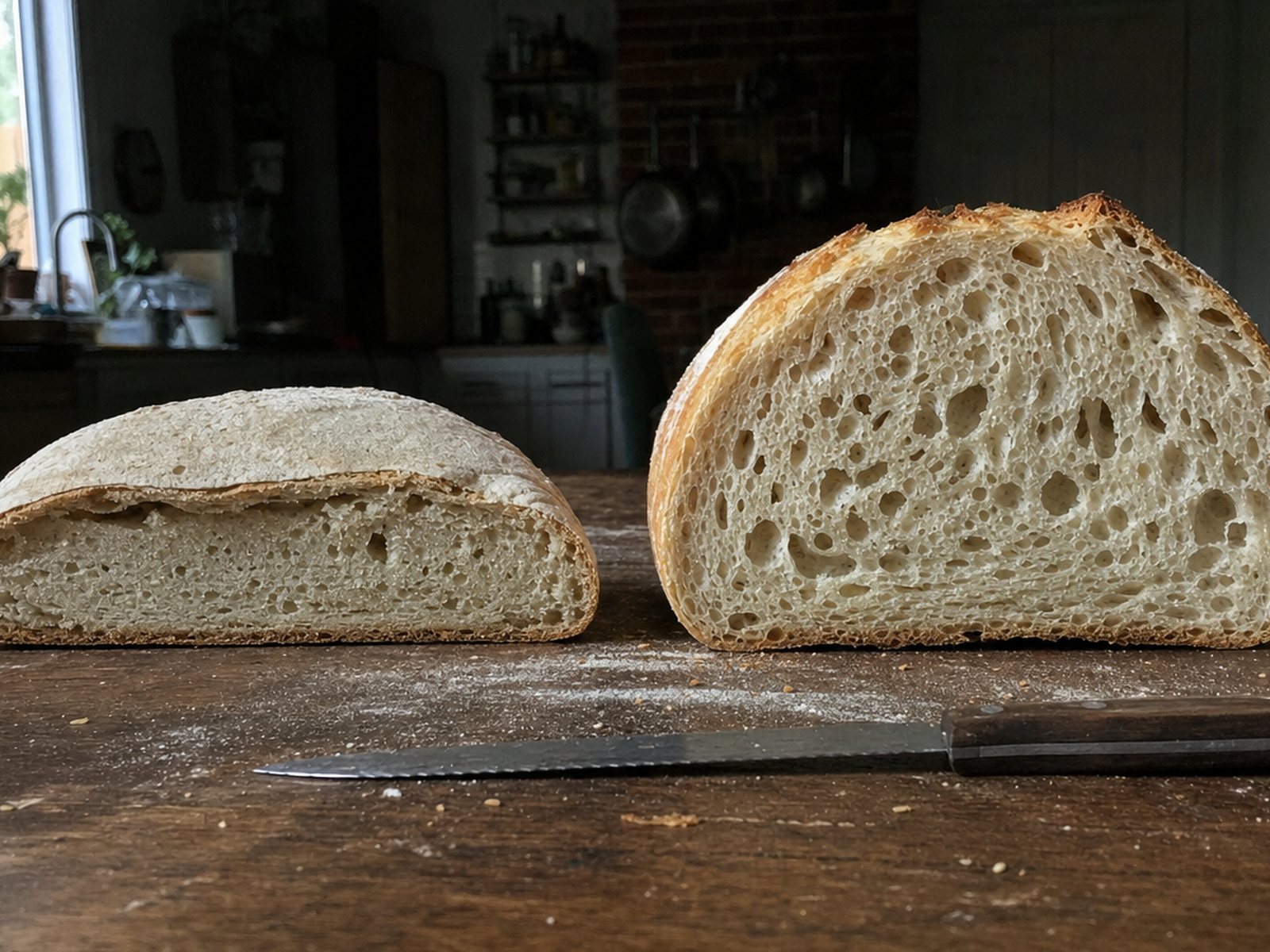
If you want to go deeper on any of the eight, the free online book covers every one of them with the science behind it. And if your bread is currently flat or dense, start with debugging your crumb.
Thanks to Mike for taking the time. You can find him at Life by Mike G on YouTube.