
The Sourdough Thermometer: 12 Temperatures Every Baker Should Know
Temperature decides almost everything in sourdough. How fast your dough ferments, when your bread is done, and how sour it tastes. I put the 12 temperatures that matter most on one thermometer, from the fridge to the oven, and checked every number against my book and the scientific literature.
Last updated: October 9, 2026.
The short version
- 4 °C (40 °F): fermentation pauses. Your dough can wait in the fridge for up to 24 hours.
- 22 to 30 °C (72 to 86 °F): the warmer your kitchen, the less starter you need. About 20 % at 22 °C, 5 to 10 % at 25 °C, 1 to 5 % at 30 °C.
- 60 °C (140 °F): yeast and bacteria die. The flour’s own enzymes keep working until about 70 °C (158 °F).
- 92 °C (197 °F): your bread is done. The crumb never gets hotter than about 100 °C (212 °F) while it still holds water.
- 105 to 120 °C (221 to 248 °F): browning starts, but only where the crust has dried out. Sugars caramelize from about 170 °C (338 °F).
- 118 °C (244 °F): acetic acid boils. It leaves with the steam long before that, mostly from the crust, while lactic acid stays. A longer bake gives a milder loaf.
The thermometer
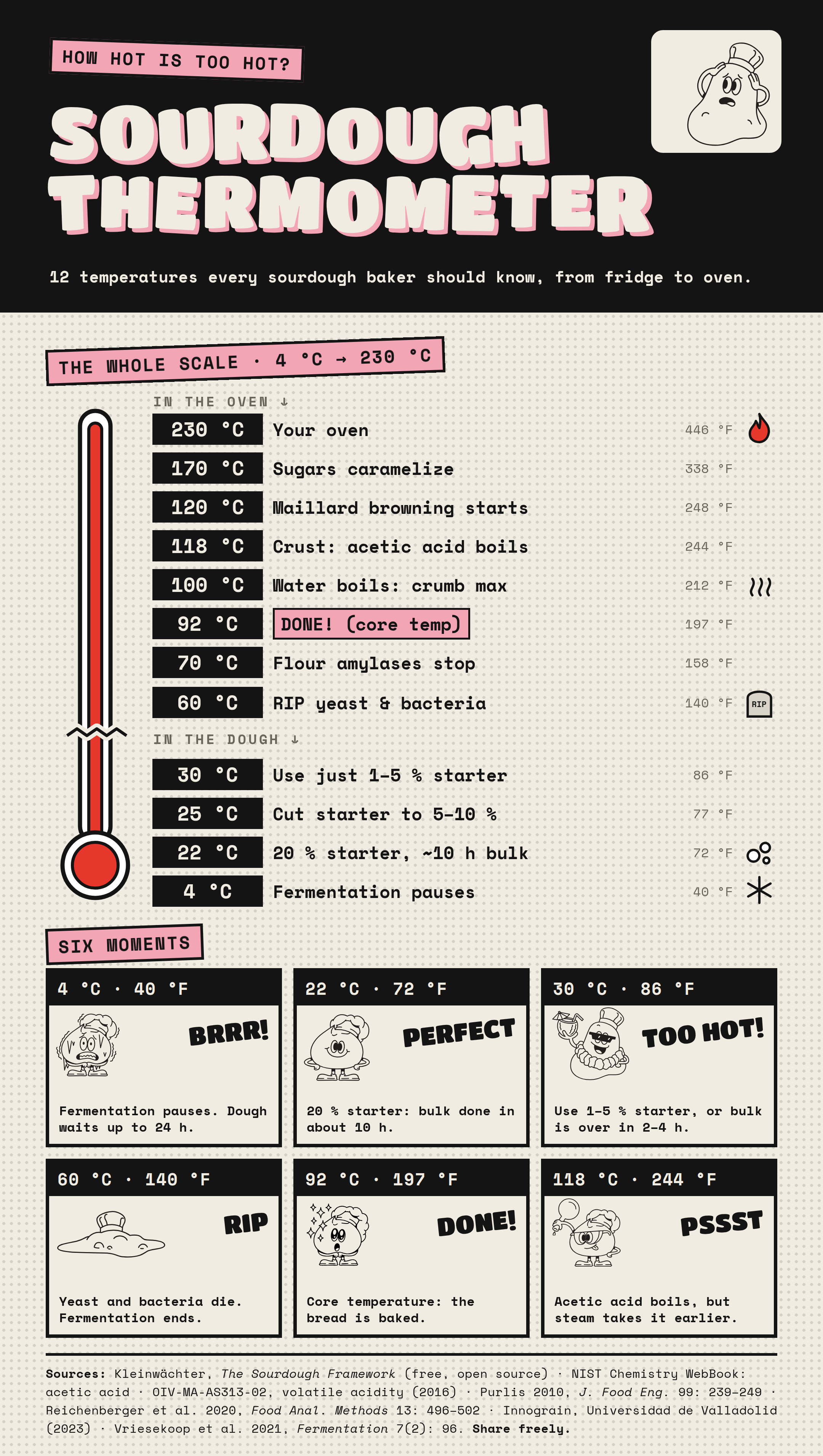
You are welcome to share it. A tag or a link back to this page is appreciated. Tap the image for the full size version.
All 12 temperatures at a glance
| Temperature | What happens | What it means for you |
|---|---|---|
| 230 °C (446 °F) | Your oven | A typical baking temperature for a sourdough loaf. |
| 170 °C (338 °F) | Sugars caramelize | The crust keeps darkening. Bake to the color you like. |
| 120 °C (248 °F) | Maillard browning starts | Only once the surface has dried out, from about 105 °C. |
| 118 °C (244 °F) | Acetic acid boils | Only the crust gets this hot. The acid leaves earlier with the steam. |
| 100 °C (212 °F) | Water boils | The highest temperature your crumb reaches. |
| 92 °C (197 °F) | Done | Measure the core with a probe thermometer. |
| 70 °C (158 °F) | Flour amylases stop | The flour’s enzymes make sugar until here. |
| 60 °C (140 °F) | Yeast and bacteria die | Fermentation ends. |
| 30 °C (86 °F) | Use 1-5 % starter | Otherwise bulk fermentation is over in 2 to 4 hours. |
| 25 °C (77 °F) | Use 5-10 % starter | Less starter keeps the timing manageable. |
| 22 °C (72 °F) | Use 20 % starter | Bulk fermentation takes about 10 hours. |
| 4 °C (40 °F) | Fermentation pauses | The dough can wait up to 24 hours. |
In the dough: 4 to 30 °C
4 °C: fermentation pauses
At fridge temperature, yeast and bacteria slow down so much that your dough barely changes. That is what makes cold retarding work: shape in the evening, bake in the morning. Your dough can wait for up to 24 hours.
22 to 30 °C: temperature and starter amount are one dial
The same dough ferments much faster in a warm kitchen. At 22 °C (72 °F), 20 % starter gives you a bulk fermentation of about 10 hours. At 25 °C (77 °F), cut the starter to 5 to 10 %. At 30 °C (86 °F), use just 1 to 5 %, or the bulk is over in 2 to 4 hours.
That is why copying the schedule of a recipe rarely works. Adjust the starter amount to your temperature, and the schedule follows. The wheat sourdough chapter of my book has a table for starter amounts by temperature.
In the oven: 60 to 230 °C
60 °C: yeast and bacteria die
Around 60 °C (140 °F) the yeast and bacteria in your dough die, and fermentation ends.
70 °C: the flour’s enzymes stop
The yeast is dead, but your flour is still working. Wheat amylases, the enzymes that turn starch into sugar, stay stable up to about 70 °C (158 °F) and are inactivated as the dough heats up further (Singh et al. 2015, Innograin 2023). For a few minutes the enzymes keep making sugar that no yeast eats anymore.
92 °C: your bread is done
Use a probe thermometer in the center of the loaf. At a core temperature of about 92 °C (197 °F) the crumb has set and the bread is baked. From here on you are mostly baking the crust.
Why the crumb never gets past 100 °C
As long as the crumb holds water, it cannot get hotter than the boiling point of water. In one measurement in a 230 °C oven, the crumb peaked at 97 °C (Reichenberger et al. 2020). Baking studies show the same picture: the crumb stays at or below 100 °C with an almost constant water content, while only the crust dries out and heats up (Purlis 2010).
Browning starts on a dry crust
Browning only starts where the surface has dried out. Once the crust passes about 105 to 120 °C (221 to 248 °F), the Maillard reaction between sugars and proteins sets in, and it speeds up the hotter the crust gets (Purlis 2010). From about 170 °C (338 °F) the remaining sugars caramelize.
This is also why steam matters at the start of the bake. A wet surface cannot dry out, so it stays soft and stretchy for oven spring instead of browning too early.
Where the sour taste goes
Acetic acid, the sharp, vinegar-like part of the sourness, boils at 118 °C (244 °F). But it does not wait for that temperature. It is volatile and leaves your dough together with the water vapor, mostly from the drying crust. Lactic acid, the mild part, barely evaporates at all. The 122 °C boiling point you sometimes read for lactic acid is measured under a strong vacuum (PubChem).
Wine labs use exactly this difference. When they separate the acids of a wine with steam, the steam carries over at least 99.5 % of the acetic acid, but no more than 0.5 % of the lactic acid (OIV). Measurements of baked sourdough bread also find less acid in the crust than in the crumb (Vriesekoop et al. 2021).
What this means for your bread:
- A longer, darker bake gives a milder loaf. More water leaves, and the acetic acid leaves with it.
- For more tang, bake shorter and keep the crust lighter.
- The crumb keeps most of its acids, because it never gets past 100 °C and keeps its water.
For the coders
If you think in code, here is the same scale as a program.
// sourdough_thermometer.js
if (temp <= 4)    fermentation.pause();
if (temp == 22)   starter = '20 %';
if (temp == 25)   starter = '5-10 %';
if (temp >= 30)   starter = '1-5 %';

if (temp >= 60)   yeast.die(); bacteria.die();
if (temp >= 70)   amylase.stop();
if (core >= 92)   bread.done = true;
if (temp >= 100)  water.evaporate();
if (crust >= 118) aceticAcid.boil();
// the crumb stays below 100 °C: more tang
if (crust >= 120) crust.maillard();
if (temp >= 170)  sugars.caramelize();

oven.preheat(230);
Sources
The fermentation numbers come from my free book The Sourdough Framework. The chemistry is checked against these sources:
- Kleinwächter, H. The Sourdough Framework, chapters Baking and Wheat sourdough.
- NIST Chemistry WebBook: Acetic acid, boiling point 118 °C.
- PubChem: Lactic acid, boiling point 122 °C at 15 mm Hg, citing the CRC Handbook of Chemistry and Physics.
- International Organisation of Vine and Wine: Volatile acidity, method OIV-MA-AS313-02 (2015).
- Purlis, E. (2010). Browning development in bakery products, a review. Journal of Food Engineering 99: 239-249. doi:10.1016/j.jfoodeng.2010.03.008
- Reichenberger, K. et al. (2020). Determination of the direct activity of the maltogenic amylase from Geobacillus stearothermophilus in white bread. Food Analytical Methods 13: 496-502. doi:10.1007/s12161-019-01673-7
- Singh, K. et al. (2015). Heat, acid and chemically induced unfolding pathways, conformational stability and structure-function relationship in wheat alpha-amylase. PLOS ONE 10(6): e0129203. doi:10.1371/journal.pone.0129203
- Innograin, Universidad de Valladolid (2023). Enzymes I.
- Vriesekoop, F. et al. (2021). Incorporation of fermented brewers spent grain in the production of sourdough bread. Fermentation 7(2): 96. doi:10.3390/fermentation7020096
Keep reading
- The best way to bake bread in your oven: oven spring without a Dutch oven.
- The last sourdough recipe: the bread I bake every week.
- Debugging your crumb: what the crumb tells you about fermentation.
Frequently asked questions
At what internal temperature is sourdough bread done?
At a core temperature of about 92 °C (197 °F). Measure it with a probe thermometer in the center of the loaf. After that you are mostly baking the crust.
Can the inside of a bread get hotter than 100 °C?
No, not while the crumb still holds water. The crumb stays at or below the boiling point of water, about 100 °C (212 °F). Measurements in a 230 °C oven found a crumb maximum of 97 °C. Only the crust dries out and gets hotter.
Does a longer bake make sourdough less sour?
Yes. Acetic acid, the sharp part of the sourness, leaves the bread together with the steam, mostly from the drying crust. Lactic acid barely evaporates. The longer you bake, the more acetic acid leaves and the milder the loaf tastes.
At what temperature do sourdough yeast and bacteria die?
At about 60 °C (140 °F). Fermentation ends there. The flour's own amylase enzymes keep working until about 70 °C (158 °F).
How much sourdough starter should I use in a warm kitchen?
At 22 °C (72 °F) about 20 % starter gives a bulk fermentation of roughly 10 hours. At 25 °C (77 °F) cut it to 5 to 10 %. At 30 °C (86 °F) use only 1 to 5 %, or bulk fermentation is over in 2 to 4 hours.