
Do You Speak Starter? 7 Things Your Sourdough Starter Is Telling You
Every baker stares at the jar at some point and wonders what it is trying to say. Is it dead? Is it ready? Did I miss it? So I made a phrasebook. Seven things your starter does, what they mean, and what to do about each one, translated with the answers from my free book The Sourdough Framework. This post goes deeper than the infographic and answers the questions bakers asked me about it.
Last updated: October 18, 2026.
The short version
- Liquid on top: not dead. That is hooch, and it protects your starter from mold. Stir it back in and feed.
- Big rise on day 3, then nothing: normal. The first rise came from the wrong microbes. Keep feeding every day.
- Risen, bubbles on the glass: ready. Mix your dough now, before the starter collapses.
- Collapsed, ring on the glass: you are late. Use half as much starter, or feed it again and wait for the next peak.
- Smells like vinegar or acetone: acetic acid, nothing bad. A liquid starter makes it milder.
- Rye barely rises: rye holds little gas. Judge it by bubbles and smell, not by height.
- Stiff starter smells boozy: normal for a stiff starter. It favors the yeast.
The phrasebook
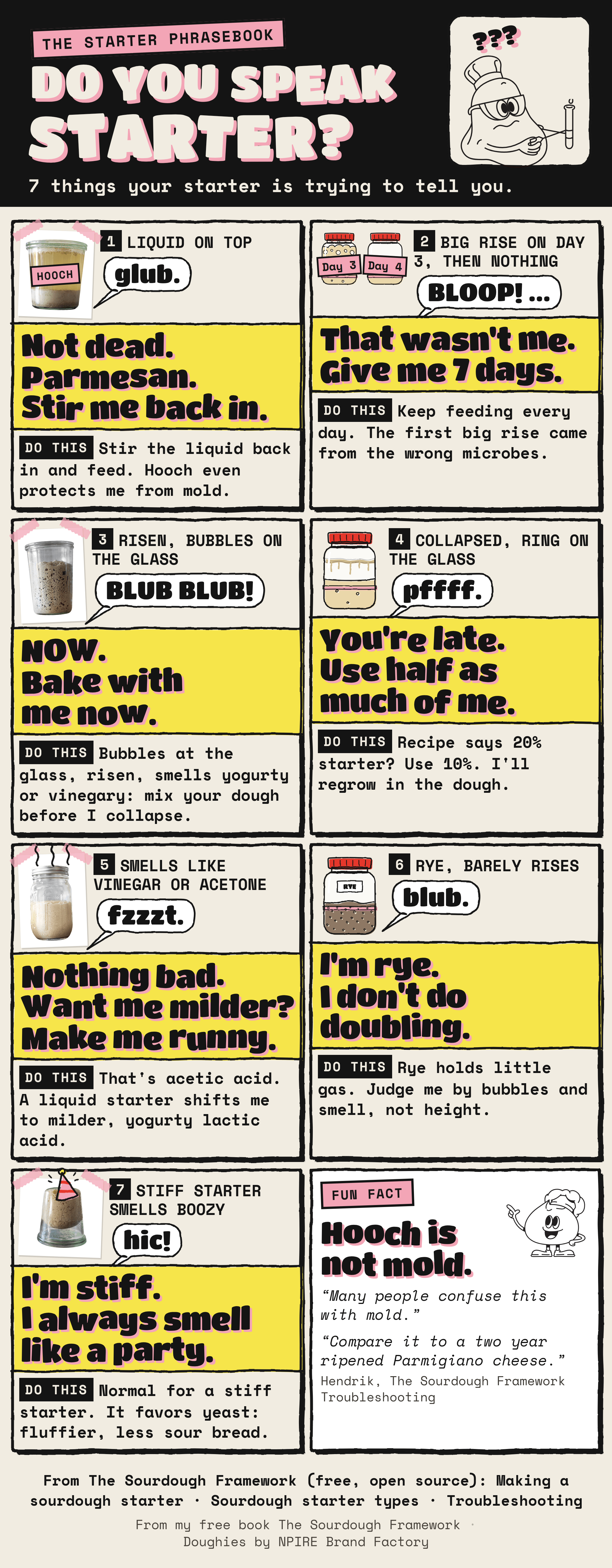
You are welcome to share it. A tag or a link back to this page is appreciated. Tap the image for the full size version.
All seven at a glance
| What you see | Your starter says | Translation | Do this |
|---|---|---|---|
| Dark liquid on top | glub. | Not dead. Parmesan. Stir me back in. | Stir the liquid in and feed. |
| Big rise on day 3, then nothing | BLOOP! … | That wasn’t me. Give me 7 days. | Keep feeding every day. |
| Risen, bubbles on the glass | BLUB BLUB! | NOW. Bake with me now. | Mix your dough before it collapses. |
| Collapsed, ring on the glass | pffff. | You’re late. Use half as much of me. | 20 % starter in the recipe? Use 10 %. |
| Smells like vinegar or acetone | fzzzt. | Nothing bad. Want me milder? Make me runny. | Convert to a liquid starter for a milder smell. |
| Rye, barely rises | blub. | I’m rye. I don’t do doubling. | Judge by bubbles and smell. |
| Stiff starter smells boozy | hic! | I’m stiff. I always smell like a party. | Nothing. It favors the yeast. |
1. Liquid on top: “Not dead. Parmesan.”
A liquid gathers on top of the jar, often grey or almost black, and it can smell pungent. Many people confuse it with mold, and I have seen bakers recommend throwing the starter away because of it. One baker told me they threw out their first starter for exactly this reason.
The liquid is called hooch. When your starter has had nothing to eat for a while, the heavier flour sinks to the bottom of the jar and the liquid stays on top. It turns darker because light flour particles and dead microorganisms float in it. Some bakers only call it hooch once it is dark, and call a clear layer water separation. It is the same thing: flour at the bottom, liquid on top.
The liquid is not a problem. It actually protects your starter from mold, because mold needs air and cannot grow well under water.
Do this: stir the hooch back into your starter. Then take a little of it and feed it to set up the starter for your next bread. If you prefer, you can also pour the liquid off and use it. I have made lacto-fermented hot sauces with it many times.
Why Parmesan? Hooch means your starter has fermented for a long time, so it is probably very sour. In my book I compare it to a two year ripened Parmigiano cheese: full of flavor. Don’t throw it away. A starter in this state makes great discard crackers or discard bread.
2. Big rise on day 3, then nothing: “That wasn’t me.”
You mix flour and water, and two or three days later the jar foams up like crazy. You are proud. The next day it is flat and quiet, and it stays that way. Many people give up right here.
This is normal. Your flour carries countless wild microbes, and in the first days all of them wake up and fight over the food. Some of the early winners, mold among them, make the starter rise a lot. They are not the microbes you want. With every feeding you select the ones that are best at fermenting flour. They start out as a tiny population, so for a few days you see little, even though there is activity on a microscopic level.
That is also why you discard the leftovers from the first days. Once you have baked your first good bread, keep every bit of discard.
Do this: keep feeding once a day. In my experience a starter takes around 7 days. For some bakers it is ready after 4 days, for others it takes 20. If nothing happens at all, check your water and flour first: chlorinated tap water stops a starter, and a whole grain flour helps.
3. Risen, bubbles on the glass: “NOW.”
This is the moment you have been waiting for. The key sign is the bubbles along the glass. The yeast produces CO2, the gas gets trapped in the starter, and you see it at the edges of the container. Add to that the size increase and the smell: a ripe starter smells sour, from yogurty to vinegary. The bubbles, the rise and the smell together tell you more than any one of them alone.
Do this: mix your dough before the starter collapses. Check it 6 to 12 hours after feeding.
How much should it rise? That depends on your flour and your microbes, not only on how active the starter is. Watch your starter rise and then fall, and remember the point just before it collapses. That is your peak, whether it is 50 %, 100 % or 200 % more volume.
And the float test? I don’t use it. It only works when the flour can hold the gas. A ready rye starter can sink, so the test says no when the answer is yes.
4. Collapsed, ring on the glass: “You’re late.”
The starter rose while you were busy, then fell back. A dried ring on the glass shows how high it got. This was the card that started the most discussion, so here is the reasoning in full.
A starter that is past its peak has run out of food. The acid keeps piling up, and the more acidic it gets, the more hostile it becomes to the yeast. The balance shifts from the yeast to the bacteria. If you use the usual amount of this starter, you bring all that acid and that balance into your dough, and your bread comes out less fluffy and more sour than it could be.
You have two options:
- Feed it again and use it at the next peak. This reliably makes the better bread, and it is what I recommend.
- Use less of it. If the recipe calls for 20 % starter, use 10 %. Your starter regrows in the dough. Remember that the dough is just a big starter with salt: with fresh flour and fewer old microbes, they have room to find a good balance again.
Less starter means a slower bulk fermentation, so give the dough more time and judge it by how it looks, not by the clock. I use option 2 when I fed my starter in the morning and did not get to the dough in the evening. When a starter has not been fed for a day, I go down to about 5 %, after two days to about 1 %.
5. Smells like vinegar or acetone: “Nothing bad.”
Some starters smell like vinegar, some like glue or nail polish remover. Both mean the same thing: your starter has produced a lot of acetic acid. When the food runs out, some of your starter’s bacteria turn the alcohol from the yeast into acetic acid, and they need oxygen to do that.
This is nothing bad. Acetic acid gives a strong, sharp flavor, which works great in a hearty rye bread.
Do this: if you want a milder bread, convert your starter into a liquid starter. The extra water keeps the oxygen out, and the lactic acid bacteria take over. Lactic acid smells and tastes mild, more like yogurt. You cannot go back once the acetic acid bacteria are gone, so keep a backup of your original starter.
6. Rye, barely rises: “I don’t do doubling.”
Many recipes tell you to wait until the starter doubles. With rye, that can mean waiting forever. Rye cannot build a gluten network, because sugars called pentosans keep the gluten bonds from forming. So a rye starter holds only a little of the gas its microbes produce, and it rises less than a wheat starter. It can still be perfectly healthy and active. A wheat starter with weak flour rises less for the same reason.
Several bakers told me their rye starter doubles anyway. That happens too: how much a starter rises depends on the flour and on the microbes. The point is that the height alone does not tell you whether your starter is ready. And in case you wondered: this card is about rye. Whole wheat is still wheat and has gluten.
Do this: judge a rye starter by the bubbles and the smell, and look for the rise and fall pattern, not a number.
7. Stiff starter smells boozy: “I always smell like a party.”
A stiff starter has a hydration of 50 to 60 %, so for 100 g of flour you use 50 to 60 g of water. It feels like pasta dough. In the stiffer environment the yeast thrives more: more CO2 and less acid. That is why a ripe stiff starter smells mild and tends to smell much more alcoholic than a regular or a liquid starter.
Do this: nothing, this is normal. Look for a dome and air pockets at the sides of the jar to see that it is ready. Your doughs will be fluffier and less sour. A lievito madre belongs to the same family, by the way. If yours smells mild and not boozy, that is fine too.
If I had to choose one starter type, I would go for the stiff starter. You can read why in Regular vs. Stiff vs. Liquid Sourdough Starter Explained.
Your starter said something else?
The phrasebook covers the seven things bakers ask me about most. If your jar is saying something that is not on the list, ask Loafy, my free sourdough assistant. It answers from The Sourdough Framework and names the chapter, and when the book does not cover a question, it says so instead of guessing. If you are making your first starter right now, the free Create Your Starter guide walks you through it in about a week.
Sources
Every translation comes from my free book The Sourdough Framework:
- Chapter 3, Making a sourdough starter: The process of making a starter and Determining starter readiness.
- Chapter 4, Sourdough starter types: Liquid starter and Stiff starter.
- Chapter 7, Wheat sourdough: Readying your starter and How much starter?.
- Chapter 12, Troubleshooting: My starter does not double in size, I made a starter, it rose on day 3 and now not anymore, Liquid on top of my starter and Why does my starter smell like vinegar or acetone?.
Keep reading
- Sourdough Starter Peak: Should It Double or Triple?: what peak performance really tells you.
- Fixing your moldy sourdough starter: when it really is mold, and how to rescue the starter.
- The Sourdough Thermometer: what your dough does at 12 temperatures, from fridge to oven.
Frequently asked questions
Is the liquid on top of my sourdough starter bad?
No. The liquid is called hooch. After a while without food, the heavier flour sinks and the liquid stays on top. It is not mold, and it even protects your starter from mold, because mold needs air. Stir it back in, or pour it off, and feed your starter.
Why did my new starter rise a lot on day 3 and then stop?
That is normal. The first big rise comes from microbes that will not win in the long run. With every feeding you select the ones that are best at fermenting flour, and they start out small. Keep feeding once a day. A starter takes around 7 days, for some bakers 4 days, for others up to 20.
How do I know my sourdough starter is ready to use?
Check it 6 to 12 hours after feeding and look at three signs together. Bubbles at the glass, an increase in size, and a sour smell that is yogurty or vinegary. Use it before it collapses. How much it rises depends on your flour, so the exact height does not matter.
Can I still use a sourdough starter that has collapsed?
Yes, but use less of it. A starter past its peak holds more acid, and the balance has shifted from the yeast to the bacteria. If the recipe says 20 % starter, use 10 %. Your starter regrows in the dough, which will need more time. The better bread comes from feeding the starter again and using it at its next peak.
Why does my sourdough starter smell like nail polish or vinegar?
That is acetic acid, and it is nothing bad. When the food runs out, some bacteria in your starter turn alcohol into acetic acid, and they need oxygen for it. For a milder, yogurty smell, convert your starter into a liquid starter, which favors lactic acid. You cannot go back after the conversion, so keep a backup.
Does a rye sourdough starter need to double?
No. Rye cannot build a gluten network, so it holds only a little of the gas. A rye starter often rises less than a wheat starter and can still be perfectly healthy. Judge it by the bubbles and the smell instead of the height.
Why does my stiff starter smell like alcohol?
A stiff starter, at 50 to 60 % hydration, favors the yeast. It makes more gas and less acid, and it tends to smell much more alcoholic than a regular starter. That is normal. Your bread gets fluffier and less sour.