
How Long Does Bulk Fermentation Take? Sourdough Times by Temperature and Starter
How long will my dough take? There is no fixed answer, because your flour, your starter and your kitchen all change it. But you still need a plan for your day. For a first guess, I have pointed bakers to Bill Wraith's rise-time table since 2020. His website is no longer reachable, so I rebuilt his table on this site, colored it and turned it into a calculator. Here is how to read it, four rules of thumb it teaches, and where it will be wrong for you.
Last updated: October 23, 2026.
The short version
- Rough ballpark figures. The times come from Bill Wraith’s rise-time model, made for his starter and his flour. Use them to plan your day, then let the dough decide.
- Warmer is faster, up to a point. Between 18 and 24 °C (64 and 75 °F), every degree Celsius warmer saves about 10 to 13 % of the time. Above 27 °C (81 °F), more warmth barely helps.
- Twice the starter cuts bulk by only about a fifth. Temperature is the stronger lever.
- Salt slows it down. 2 % salt makes every time about 20 % longer than no salt.
- Your starter sets the pace. At 22 °C (72 °F) with 20 % starter, my dough needs around 10 hours. The model says 6½.
The table
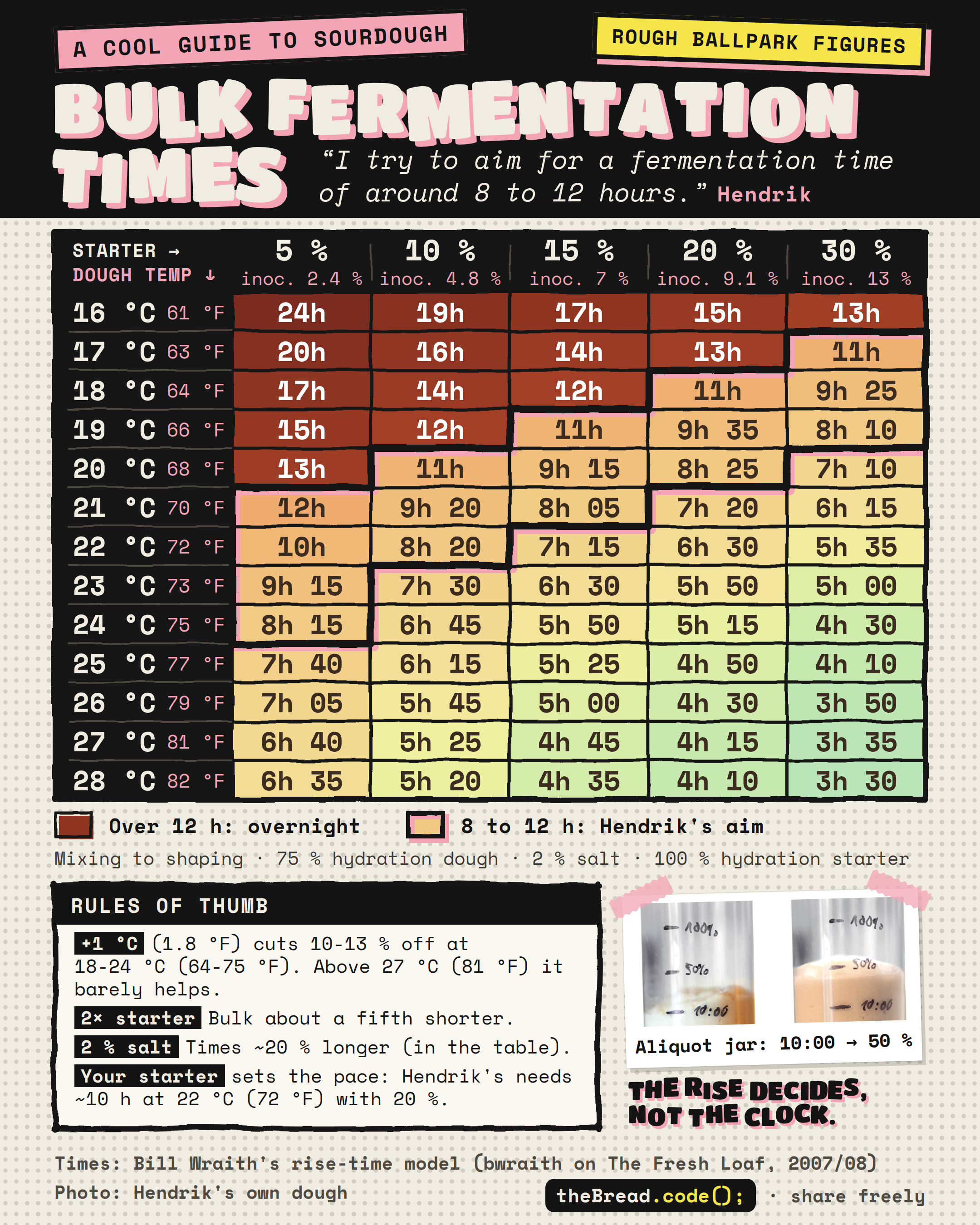
You are welcome to share it. A tag or a link back to this page is appreciated. Tap the image for the full size version.
For every temperature and starter amount in between, use the fermentation table and calculator. It converts other starter hydrations, has a setting without salt for a levain, plans your day from mixing to baking and can scale every time to your own starter.
In Loafy, my free sourdough app, the same estimate comes from three models: Bill’s, the figures from my book and, with a free account, your own starter from your bake journal. Open it in Loafy.
How to read it
- Find your dough temperature. Measure the dough, not the room. A probe thermometer in the dough is enough.
- Go across to your starter amount, as a percentage of the flour weight, for a starter at 100 % hydration. The small “inoc.” number under it is what Bill’s model counts: the flour inside your starter as a share of all the flour in the dough. 20 % starter is about 9 % inoculation.
- Read the time. It is the bulk fermentation, from mixing until you shape, for a dough with 75 % hydration and 2 % salt.
A dough at 24 °C (75 °F) with 10 % starter takes about 6 hours 45 minutes. The light cells go up to about 12 hours. The dark red ones take longer: that is overnight territory. The outlined cells are my aim. I try to aim for a fermentation time of around 8 to 12 hours, which seems to be the sweet spot for most of the flours I have worked with. The enzymes get enough time to break down the flour.
Four rules of thumb
1. Warmer is faster, until about 27 °C
Between 18 and 24 °C (64 and 75 °F), every degree Celsius warmer saves about 10 to 13 % of the time. Below 18 °C it is about 15 % per degree, so a cold kitchen slows your dough down a lot. A dough with 5 % starter needs about 13 hours at 20 °C (68 °F) and a little over 8 hours at 24 °C (75 °F).
Above 27 °C (81 °F), more warmth barely helps. With 5 % starter the model gives 6 hours 40 minutes at 27 °C and 6 hours 35 minutes at 28 °C.
2. Twice the starter, about a fifth shorter
More starter brings more microorganisms into your dough, so it ferments faster. But the effect is smaller than most bakers expect. Twice the starter cuts bulk fermentation by only about a fifth, 16 to 25 % in the model. At 22 °C (72 °F), going from 10 to 20 % starter takes bulk fermentation from 8 hours 20 minutes to 6 hours 30 minutes. Two degrees warmer would do about as much.
I use less starter than most bakers: around 5 % in summer and 10 to 20 % in winter. The section How much starter? in my book explains why.
3. Salt slows everything down
The table is for a dough with 2 % salt. In Bill’s model, 2 % salt makes every time about 20 % longer than no salt. That is one reason a levain ferments faster than the bread dough you make from it. For times without salt, pick “Levain or starter” in the calculator.
4. Your starter sets the pace
Bill tuned the model to his starter and a flour mix of about 85 % white flour, 10 % whole wheat and 5 % whole rye. Your starter can be much faster or slower. Mine is slower: at around 22 °C (72 °F) in my kitchen, with about 20 % starter, my bulk fermentation is ready after around 10 hours. Bill’s model says 6½.
Bill’s tip makes the table yours. Feed your starter, note when it has doubled and compare that with the model. If your starter takes 30 % longer, add 30 % to every time in the table. The calculator does this for you under “Make it fit your starter”.
What the table doesn’t know
Every time in it is a rough ballpark figure. These are its known limits:
- Bill’s starter, Bill’s flour. Your starter and your flour are different.
- One kind of dough. 75 % hydration with mostly white flour. Whole grain, very stiff or very wet doughs, and doughs with sugar, butter, milk or eggs ferment differently.
- One temperature from start to finish. Real kitchens warm up and cool down. A cold proof in the fridge isn’t covered at all.
- A limited range. 10 to 29.4 °C (50 to 85 °F), and 1 to about 66 % starter (0.5 to 25 % inoculation).
- Estimates in between. Bill’s table has 5 °F steps and eight starter amounts. Everything in between is interpolated.
The full list is on the fermentation table page.
When is bulk fermentation done?
Not when the table says so. The table tells you when to start looking. My book puts it plainly: “The worst thing you can do when fermenting sourdough is to rely on a recipe’s timing suggestions.” That includes this table.
Judge the dough by its size. My go-to method is an aliquot jar: a small sample of your dough in a straight-sided jar, marked at the start. When the sample has grown by your target, the main dough has too. On the poster, my sample took 10 hours to grow by 50 %. How much it should grow depends on the protein in your flour:
| Flour protein | Size increase to aim for |
|---|---|
| 8 to 10 % | 25 % |
| 10 to 12 % | 50 % |
| 12 to 15 % | 100 % |
| more than 15 % | more than 100 % |
For all the ways to tell, follow the bulk fermentation chart in my book. Do You Speak Dough? translates seven things your dough tells you during bulk fermentation.
For the programmers: the Ruby edition
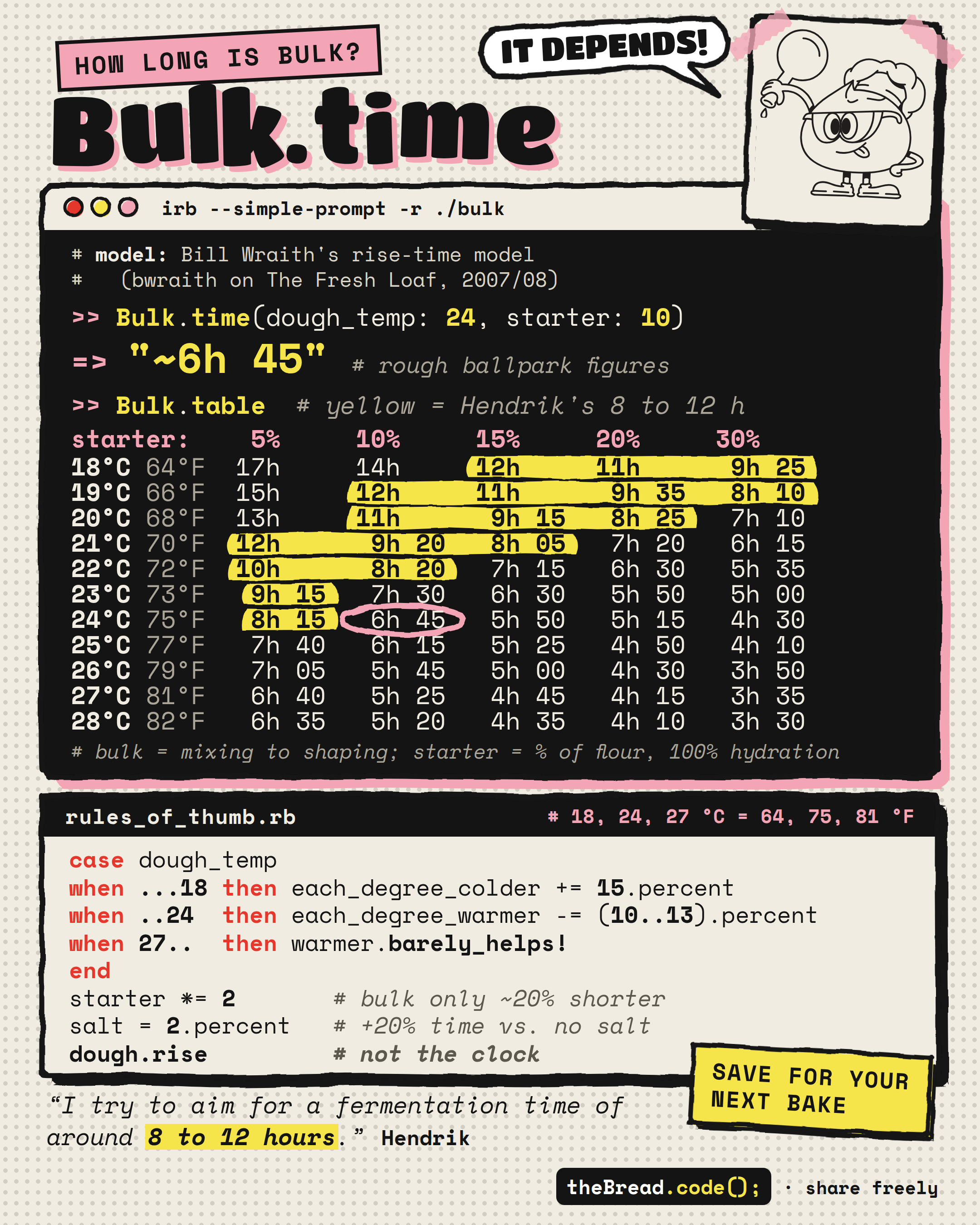
The same numbers as an irb session. The rules of thumb end where they should:
dough.rise # not the clock.
Credit where it belongs
The model and every number in the table are by Bill Wraith, known as bwraith on The Fresh Loaf. He built it in 2007 and 2008 from his own test doughs, scientific papers and baking books, and shared it on The Fresh Loaf with the words “Use it as is, and modify it as you like.” His website is no longer reachable, so I keep his original table, unchanged, on this site. The colors, the calculator and the poster are my easier way to read it. Thank you, Bill.
Your dough does something else?
If your dough doesn’t behave like the table, ask Loafy, my free sourdough assistant. It answers from The Sourdough Framework and names the chapter, and when the book does not cover a question, it says so instead of guessing.
Sources
- Bill Wraith (bwraith): Sourdough Rise Time Modelling and Recipe Calculators, The Fresh Loaf, 2007, and his original table.
- My free book The Sourdough Framework, chapter 7, Wheat sourdough: How much starter?, Bulk fermentation, the bulk fermentation chart and how much the dough should grow.
Keep reading
- The fermentation table and calculator: every temperature and starter amount, with proofing and a plan for your day.
- Do You Speak Dough?: seven things your sourdough tells you during bulk fermentation.
- The Sourdough Thermometer: what your dough does at 12 temperatures, from fridge to oven.
- The Last Sourdough Bread Recipe You Ever Need: my recipe, step by step.
Frequently asked questions
How long does sourdough bulk fermentation take at 24 °C?
With 10 % starter and 2 % salt, Bill Wraith's rise-time model gives about 6 hours 45 minutes. With 20 % starter it is about 5 hours 15 minutes. Treat it as a first guess. Bulk fermentation is done when your dough has grown by the amount your flour can take, not when the clock says so.
Does more starter make bulk fermentation faster?
Yes, but less than most bakers expect. Twice the starter cuts bulk fermentation by only about a fifth, 16 to 25 % in Bill Wraith's model. Temperature is the stronger lever. Between 18 and 24 °C (64 and 75 °F), two degrees warmer does about as much as twice the starter.
How much does temperature change bulk fermentation?
Between 18 and 24 °C (64 and 75 °F), every degree Celsius warmer saves about 10 to 13 % of the time. Below 18 °C it is about 15 % per degree. Above 27 °C (81 °F), more warmth barely speeds the dough up.
Does salt slow down sourdough fermentation?
Yes. In Bill Wraith's model, 2 % salt makes every time about 20 % longer than no salt. That is one reason a levain without salt ferments faster than the bread dough you make from it.
Why does my bulk fermentation take longer than the table says?
Because your starter and your flour are not Bill's. Starters differ a lot. Mine needs around 10 hours at 22 °C (72 °F) with 20 % starter, where the model says 6½. Feed your starter, note when it has doubled, compare that with the model and scale every time in the table by the difference.
Does the table work for a cold bulk fermentation in the fridge?
No. The model assumes one temperature from mixing to baking, between 10 and 29.4 °C (50 and 85 °F). A cold bulk fermentation or a cold proof in the fridge is not covered.